
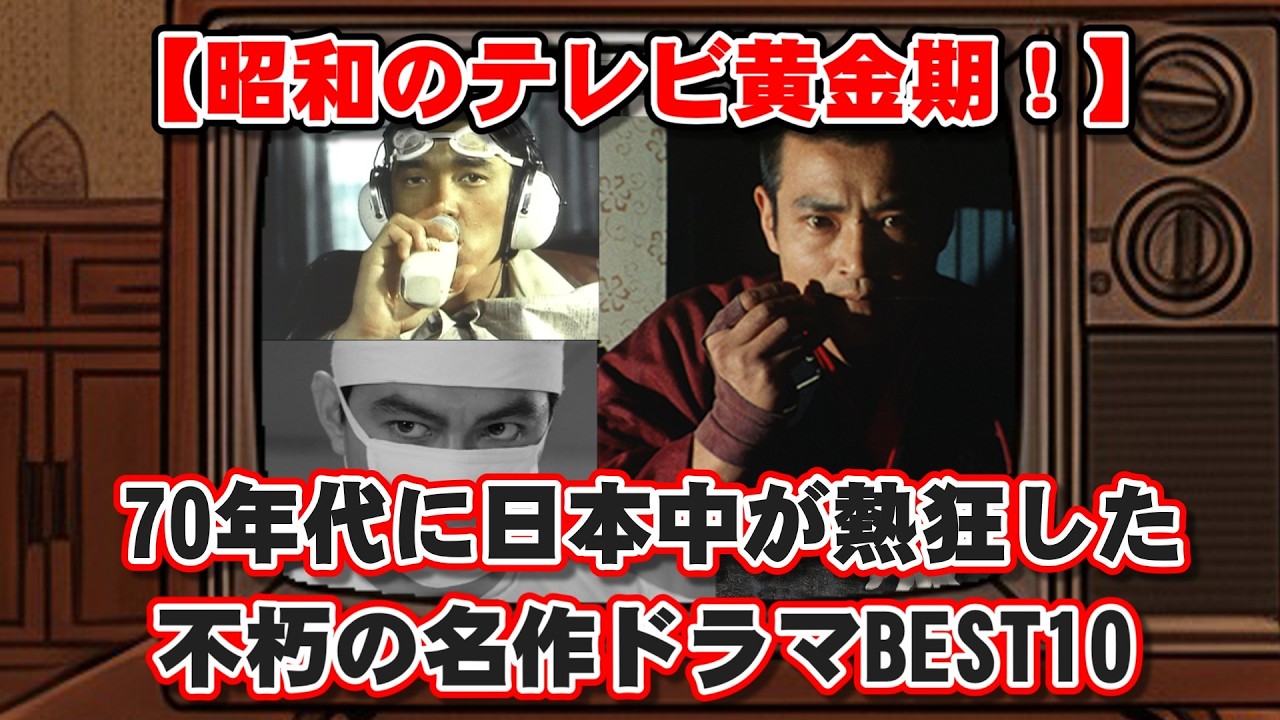
【ゆっくり解説】昭和のテレビ黄金期!70年代に日本中が熱狂した不朽の名作ドラマBEST10
【ゆっくり解説】昭和のテレビ黄金期!70年代に日本中が熱狂した不朽の名作ドラマBEST10
概要
1970年代は日本のテレビ史に輝く黄金期!『太陽にほえろ!』『白い巨塔』『岸辺のアルバム』など、今なお語り継がれる不朽の名作ドラマが次々と誕生しました。常識を打ち破った革新的な傑作の数々を、懐かしい思い出と共にランキング形式で一挙にご紹介します。あなたの心に残る一本は、果たして何位にランクインしているでしょうか?
■立ち絵:坂本アヒル
https://seiga.nicovideo.jp/seiga/im10…
■ウィキペディア
■いらすとや
[フリーBGM DOVA-SYNDROME / FREE BGM DOVA-SYNDROME] https://dova-s.jp/ #freebgm #フリーBGM #dovasyndrome
0:00 前説(イントロ)
1:08 第10位: 寺内貫太郎一家 (1974年)
3:19 第9位: 木枯し紋次郎 (1972年)
5:37 第8位: 俺たちの旅 (1975年)
8:00 第7位: 西遊記 (1978年)
10:16 第6位: 傷だらけの天使 (1974年)
12:25 第5位: 必殺仕掛人 (1972年)
14:49 第4位: 赤い疑惑 (1975年)
17:14 第3位: 白い巨塔 (1978年)
19:35 第2位: 岸辺のアルバム (1977年)
22:06 第1位: 太陽にほえろ! (1972年)
24:55 総評・まとめ
[Slow Commentary] The Golden Age of Showa Television! Top 10 Timeless Classic Dramas That Caught Japan’s Craze in the 1970s Marisa, today’s theme is TV dramas from the 1970s! It’s so exciting! Yeah! This time, we’ll be introducing a ranking of the timeless classic dramas that ravaged Japan in the 1970s , the “golden age” of Japanese TV drama history ! The Golden Age! Why was the 1970s so special? Well, it was because society at the time was at a major turning point. The period of rapid economic growth that had continued for so long came to an end, and the 1973 oil crisis brought chaos to Japan. It was also a time when the “nuclear family” became the norm and people’s values were greatly shaken. I see… Perhaps it was this turbulent time that gave birth to memorable dramas. Absolutely. That’s why today, I’ll be taking a closer look at the top 10 of these legendary dramas ! 10th Place – The Terauchi Kantaro Family (1974) The rankings are finally here! I wonder what kind of drama is in this memorable 10th place? Let’s get started! 10th place is a monumental family drama that had the whole family glued to their living rooms! It’s “The Terauchi Kantaro Family,” which aired in 1974! Oh, I’ve heard the title before! It’s set in a stonemason’s shop in downtown Tokyo, right? An average audience rating of 31.3% is amazing! That’s right! The charm of this drama is, without a doubt, the strong character of the main character, Terauchi Kantaro, played by Kobayashi Asei. He’s a stubborn Showa-era father who will immediately upset the table if something doesn’t please him, and he gets into serious fistfights with his son, Shuhei. What!? It’s hard to imagine now! But maybe that just shows how serious he was. Yes, he was serious about it. It’s a well-known story that during a fight scene with Hideki Saijo, who played Shuhei, he got so worked up that he actually broke his arm. Really?! This episode is unique to this drama, which boasts a lot of ad-libs and a vivid sense of realism. You can almost feel the actors’ passion, like sparks flying… right? But this drama isn’t just outrageous. The scene in which Grandma Kin, played by Chiho Yuki (later known as Kirin Kiki), yells “Julie!” at a poster of Kenji Sawada became a social phenomenon. “Julie!” I can almost picture it. The image of a grandmother so passionate about an idol is so human and charming. It’s true. Not only is it hilarious, but the renowned screenwriter Kuniko Mukoda, who wrote the script, also explores profound themes like family ties and aging through Kantaro, who is modeled after her own father . That’s why it went beyond mere comedy and became a timeless masterpiece. #9 – Kogarashi Monjiro (1972) #10’s “Terauchi Kantaro Ikka” was amazing! It completely overturned the conventional wisdom of family dramas. I wonder what drama will come next? Next up is a work that completely overturns the conventional wisdom of period dramas! #9 is “Kogarashi Monjiro,” which aired in 1972 and starred Nakamura Atsuo! ” Kogarashi Monjiro!” I’ve heard the name before. I’m sure it’s the story of a traveling merchant who is characterized by holding a toothpick in his mouth, right? That’s right! Monjiro was a completely different character from previous period drama heroes: a nihilistic, solitary anti-hero. The show peaked at 38%, and the reason for this was Monjiro’s style of avoiding contact with others. What? He’s a hero, after all? Isn’t it standard in period dramas to help people in need? That was what made it so revolutionary. Wearing a tattered raincoat and his trademark long toothpick in his mouth, Monjiro mutters his famous catchphrase whenever he’s about to get caught up in a troublesome incident : “None of my business…” Oh ! I know that! It’s the catchphrase everyone imitates . But does that really mean he won’t get involved? Well, he does end up getting caught up in the incident and defeating the bad guys. But his fighting style is also unique. It’s more down-to-earth and realistic than sword fighting. Since he hasn’t trained in swordsmanship, he doesn’t engage in elegant sword fights, but rather swings his sword around, slams it down, and stabs with the tip of his sword. It’s literally a fight for survival. Wow! So they pursued realism in the fighting scenes as well. It’s kind of cool… right? This thorough realism, combined with director Kon Ichikawa’s stylish visuals and the huge success of the theme song, “Someone in the Wind,” which isn’t typical of a period drama, creates a unique worldview. That’s why “Kogarashi Monjiro” is not just a period drama, but a legendary work that established a completely new image of the hero. #8 – Our Journey (1975) I wonder what genre of drama will come next after this nihilistic period drama? I’m excited! Yes, the next one will have a completely different vibe! #8 is a monumental youth drama that was a hit with young people at the time! “Our Journey,” aired in 1975! Our Journey! It’s a very famous drama starring Masatoshi Nakamura. I think it had three young protagonists? That’s right! The protagonists were a trio: the hot-tempered “Kasusuke” played by Masatoshi Nakamura, the timid “Omeda” played by Ken Tanaka , and the indecisive senior “Guzuroku” played by Masaaki Tsusaka , who now plays Taisaku Akino . These three useless yet somehow lovable characters were amazing. Even their nicknames are unique and interesting. What kind of journey do they embark on? It’s not a physical one. They graduate from college and become salaried workers. But they quickly drop out, bound by the unreasonable rules of society, saying, “This isn’t the way we live!” What? They worked so hard to get a job!? That’s a pretty bold decision. What do they do next? This is where the drama really shines. They break away from society’s rails and start a handyman-like company called “Something Will Do It” with their friends . They struggle to live life their own way, with their own strength. Something Will Do It! In an era where there were no right answers, their search for their own way of life was a bible for young people at the time as they “discovered themselves.” And that’s exactly right. The realistic worries and conflicts of young people depicted by renowned screenwriter Toshio Kamata, perfectly synchronized with the theme song sung by Masatoshi Nakamura, created a social phenomenon. It’s not just a teen drama; its message captured the atmosphere of a stagnant era, making it a legendary work that has become a bible for many young people on how to live. No. 7 – Journey to the West (1978) “Our Journey” was the very definition of youth. So, what drama will be next? It’s an adventure fantasy that captivated the whole family, from children to adults! In seventh place is “Journey to the West,” which aired in 1978 and starred Masaaki Sakai! Journey to the West! It’s the story of Son Goku accompanying Tripitaka on his journey to India! I remember the visuals were incredibly lavish. That’s right! It was a program celebrating the 25th anniversary of Nippon Television’s launch, and the production cost 1 billion yen! It was an incredibly generous budget at the time. Son Goku was played by Masaaki Sakai, Zhu Bajie by Toshiyuki Nishida, Sha Gojyo by Shiro Kishibe, and Tripitaka was played by actress Masako Natsume. Masako Natsume’s Tripitaka was very impressive. He was dignified and beautiful… But Tripitaka is actually a man, right? Ah, that was the drama’s greatest innovation. By having actress Natsume play the role, Tripitaka was portrayed as noble, strong-willed, and above all, beautiful. This had such a huge impact that it became standard practice for Tripitaka to be played by an actress in Japanese dramas ever since . It was a historic casting move! I’ve heard the special effects were also amazing. After all, they’re all produced by Tsuburaya Productions. The opening scene, where Son Goku is born from a stone, is particularly famous. It took two months to film just 60 seconds of footage, with a production budget of 15 million yen— the level of detail is incredible. 15 million yen in 60 seconds?! The scale is just too big… That’s it. The epic scale, captivating characters, and Godiego’s huge success with “Monkey Magic” and “Gandhara” combined to make this a legendary entertainment piece representing the 1970s , enthusiastically received not only in Japan but also in Asia and Europe . It’s a show that can be proudly shown overseas. #6 – Scarred Angel (1974) Journey to the West is gorgeous and dreamy! It brought back the excitement of my childhood. So, what kind of drama is in #6? This next one is the complete opposite of a dream: a super cool and shocking work! #6 is “Scarred Angel,” starring Kenichi Hagiwara and Yutaka Mizutani, which aired in 1974! Scarred Angel! I have an image of it being a very stylish and fashionable drama. It features two outlaws as the main characters. That’s right! The main characters are Osamu, a rough but kind-hearted man played by Kenichi Hagiwara, and Osamu, a man who calls him “Big Brother!” ” Toru is innocent and somehow fleeting, yearning for his wife. The way these two lived their lives was just so cool. The penthouse they lived in on the roof of a building in Yoyogi really made an impression on me. It had a unique, decadent atmosphere. Ah, that “Angel Building.” And the opening scene was especially revolutionary. Wearing headphones, Osamu takes tomatoes and corned beef out of the refrigerator, eats them, and drinks milk straight from a bottle. That footage is an invention that will go down in television history. That scene is truly famous! But I’ve heard the story was quite harsh… Ah, the final episode in particular is legendary. Toru jumps into a fountain in the middle of winter in search of tips, but dies suddenly of pneumonia. Then Osamu stuffs Toru’s body into a drum and goes alone to dispose of it on Dream Island… Wow… What a sad ending. There ‘s no hope at all… That’s right. The image of Osamu carrying Toru’s body in a drum symbolized the loneliness of young people living at the bottom of society and the hopeless despair that comes with resisting an unreasonable reality. It’s precisely because of this fleeting brilliance and its depiction of a hopeless reality that this drama remains legendary as a cry from the souls of young people. 5th Place – Hissatsu Shikakenin (1972) “Scarred Angel” was so shocking… But that’s exactly why it’s legendary. Now, it’s time to announce our top 5! Here comes the most legendary of legends! In fifth place is a highly controversial work that completely overturned the history of period dramas up to that point! It’s the first of the memorable “Hissatsu Series,” ” Hissatsu Shikakenin,” broadcast in 1972! The Hissatsu Series! This is where that nationally beloved period drama began! ” Shikakenin” definitely refers to a “slasher,” right? That’s right! What made this drama so revolutionary was that it completely ignored the conventional wisdom of period dramas up until that point— rewarding good and punishing evil. Its protagonist wasn’t a hero, but rather a paid assassin who buries villains in the shadows. Even now, it’s an incredible premise, with assassins contracted for money playing the main characters. Who were the assassins? There were two main assassins. Fujieda Baian, played by Ogata Ken, is a skilled acupuncturist on the surface. And Nishimura Sanai, played by Hayashi Yoichi, is a married, family-loving ronin. The contrast between their daytime personas and their nighttime assassin personas was stark. An acupuncturist and a married, family-loving ronin… It’s hard to believe they were assassins. How did they target evildoers? Baian’s method of assassinating was particularly symbolic. He used acupuncture needles, the very needles he normally uses to save people’s lives. He would pierce the neck or forehead of the villain with the needle, killing them with a single blow. Viewers were thrilled by his cold-hearted demeanor, using a sacred tool to punish evil. Eek! It’s precisely because it’s a sacred tool that it feels even more terrifying and intimidating… right? The film was directed by Kinji Fukasaku, director of “Battles Without Honor and Humanity,” who thoroughly crafted a hard-boiled worldview with beautiful visuals that emphasized light and shadow and a music reminiscent of a spaghetti western . It’s precisely because of this challenging style that the “History Series” has become a Japanese treasure that has endured for over 50 years. #4 – Red Suspicion (1975) “History Series”: The story behind the birth of the dark hero was fascinating. It completely changed the image of period dramas. So, what’s #4? Next up is a shocking love story that moved the whole of Japan to tears! In fourth place is “Akai Giwaku,” the second installment of the legendary “Akai Series,” broadcast in 1975! The Red Series! The golden duo of Momoe Yamaguchi and Tomokazu Miura! “Akai Giwaku” was the first time the two co-starred in a drama, right? That’s right! It truly is the beginning of the legend. What’s amazing about this drama is the endless parade of misfortunes , unimaginable in today’s dramas . The heroine, Sachiko, played by Momoe Yamaguchi, is exposed to radiation in a university explosion and develops leukemia. Ugh… What a sudden and heavy turn of events. At the time, leukemia was widely perceived as an incurable disease, so it must have been quite a shock to viewers. The whole of Japan shed tears over Sachiko’s battle with the disease. But the real hell was yet to come. The story’s main theme is “the secret of birth.” Surprisingly, Sachiko wasn’t the biological daughter of her father, played by Ken Utsui . Her real mother was her father’s sister, in other words, her aunt. What!? So the daughter her father was raising was actually her sister’s child? That’s too complicated… right? But that’s just the beginning. Sachiko falls deeply in love with Mitsuo, a medical student played by Tomokazu Miura, who helped her . But, midway through the story, it turns out that these two are… “half-siblings. ” Half-siblings?! The people they loved were actually blood siblings… That can only be described as a tragedy… That’s right. Leukemia, a secret about their birth, and forbidden love. A rollercoaster of a story that hits you with an incredibly cruel fate, the highest viewer rating recorded was 30.9%. It truly showed the world the true essence of “Daiei Drama.” It’s a timeless masterpiece. 3rd Place – The White Tower (1978) “Red Suspicion” was so shocking… The charm of this golden duo and the endless string of misfortunes that befall them are truly legendary. So, what’s the third place winner? This next one is more than just a drama; it’s a social phenomenon! 3rd place goes to “The White Tower,” a towering figure in the history of Japanese television dramas! Broadcast in 1978, it stars Jiro Tamiya! The White Tower! It’s a profound human drama set in a university hospital. It’s been remade many times, but Tamiya Jiro’s character, Goro Zaizen, remains the most memorable. Yes, that’s true. This drama can’t be discussed without Jiro Tamiya. The protagonist, Goro Zaizen, is a brilliant surgeon, but also an ambitious man who will stop at nothing for fame and power. He ‘s a fascinating character, possessing both light and dark sides. The story begins with a battle for the professor position, right? Yes, the first half of the story depicts the nasty factional battles and “professor election” in the closed world of a university hospital . Zaizen uses all sorts of schemes to finally rise to the top position of Professor of First Surgery. The terrifying part of this story is how he falls from there, even though he reaches the top… That’s right. The second half focuses on a “medical trial” in which Zaizen is sued by the family of a patient who performed surgery on him . Here, Zaizen’s ethics as a doctor are called into question, and he is gradually cornered. And what really made this drama legendary was the presence of lead actor Jiro Tamiya… Ah… he devoted his entire acting career to the role of Goro Zaizen. Tamiya, who portrayed Zaizen’s rise and fall with a terrifying performance , took his own life just before the final episode of the drama aired . This heroic way of life intertwined with Zaizen’s fate, making “The White Tower” more than just a drama; it became a legendary work. No. 2 – Album on the Shore (1977) “The White Tower” was a profoundly moving drama… It felt like it showed the depths of human suffering. And now, finally, number two! Up next is a major event in the history of family dramas that completely shattered the conventional wisdom of the living room ! Number two is “Album on the Shore,” a timeless masterpiece written by screenwriter Taichi Yamada, broadcast in 1977! Album on the Shore! At first glance, it seems like a happy family story… but it gradually takes a sinister turn. That’s right! This drama was revolutionary because it completely shattered the illusions of “family togetherness” and “happy endings” that had been established up until then . It truly overturned the very concept of family dramas. I’m sure each family member harbors a secret. The mother’s affair was particularly shocking. Yachigusa Kaoru, who had been the epitome of a good wife and mother, falls in love with a man other than her husband. But that’s not all. The husband, played by Sugiura Naoki, commits fraud at work, the daughter is raped, and the son, played by Kunihiro Tomiyuki, is tormented when he discovers the family’s secrets. Just listening to it is painful… No one is saved. It was truly frightening to see this seemingly peaceful family quietly crumble from within. The drama’s incredible power is in the way it depicts this “collapse” visually. First, the opening scene. With Janis Ian’s melancholy classic “Will You Dance?” playing in the background, news footage of the actual Tamagawa River floods suddenly plays, showing a house being swallowed up by the muddy waters . It was intense! Their home, a symbol of a happy family, is being washed away right from the start of the drama… And at the end of the story, this family’s home is truly engulfed by the Tamagawa River’s muddy currents. The family bond and the home that symbolized it all physically collapse. The only thing they carry with them is an “album” filled with photos of their family members wearing fake smiles. This is a masterpiece in television history , depicting the fragility and loneliness of family without any sugarcoating . #1 – Taiyo ni Hoero! (1972) “Kishibe no Album” was a shocking work that overturned the concept of home dramas … So, which drama will surpass the many other masterpieces and reign supreme among the 1970s dramas? Ah, the time has finally come to reveal the winner! The golden age of Showa television, the timeless drama that captivated Japan in the 1970s, holds the honor of being number one… a monumental Japanese detective drama that aired for over 14 years ! “Taiyo ni Hoero!” Of course! This drama is number one! I was particularly impressed by how the detectives , led by “Boss” played by Yujiro Ishihara, called each other by their nicknames. That’s right! “Yama-san,” “Gori-san,” “His Highness”… The Nanamagari Police Department’s First Investigative Division was a team that felt like one family. But the biggest reason this drama became an enduring legend is, without a doubt, its groundbreaking system of “rookie detectives dying in the line of duty. ” Death in the line of duty… Yes, as a child, it was incredibly shocking to see young detectives die one after another in this drama. It all began with the death of the first rookie detective, “Macaroni,” played by Kenichi Hagiwara. Just one year after the show began, the lead detective was stabbed by a random assailant and killed unceremoniously. This shocking turn of events determined the direction of the drama. It was unheard of for a main character to die in just one year. Normally, that would have ended the show. Yeah. But from this point on, the style of “rookie detectives being assigned, growing, eventually graduating in the line of duty, and passing the baton to the next rookie” was established. From Macaroni to Yusaku Matsuda’s “Jeans,” to Hiroshi Katsuno’s “Texas,” and Jun Miyauchi’s “Bon,” a popular detective died in the line of duty every year, and a new hero was born. This shocking cycle captivated viewers. I see ! That’s why the series has maintained its popularity for over 14 years without becoming stale! I couldn’t watch any of the death scenes without crying. The most legendary scene is Detective Jeans’s final moments. Shot by the criminal, he mutters the legendary line, “What the heck is this?” as he watches the blood flow from his body. This scene is forever etched in the history of Japanese drama. This series, which has depicted human drama and “jeans” head-on and continued to produce many stars , truly is the king of dramas. Overall Review (Summary) : This ranking was amazing! From detective dramas to family dramas, it’s filled with masterpieces, and I’m overwhelmed! Right? It’s truly a golden age. “Taiyo ni Hoero!” There were classics like “The Album of the Shore,” as well as dramas depicting the breakdown of a family like “Kishibe no Album.” It was a time filled with truly challenging and diverse works. In particular, the protagonists with darker personalities, who weren’t simply champions of justice, like in “Hijikata Shikakenin” and “Kizudareke no Tenshi,” were very appealing. Ah, that’s right. I couldn’t introduce them all this time, but there are still many legendary dramas like the hard-boiled “G-Men ’75” and “Detective Story,” in which Matsuda Yusaku’s charm exploded. In this era when television was at its most brilliant and influential, dramas were not just entertainment, but also moved people’s hearts and served as a mirror reflecting a changing society. So, what was your favorite 70s drama? Let me know in the comments! I’d love to hear about your favorite shows! If you enjoyed this video, please give it a thumbs up and subscribe!
28 Comments
「のさばる悪をなんとする?天の裁きは待ってはおれぬ。この世の正義も当てにはならぬ。闇に裁いて仕置きする。南無阿弥陀仏」。
自分は必殺のシリーズ最高傑作は「新・必殺仕置人」だと考えております。身分も出自も違う「仕置人」たちが繰り出すユニークな文字通りの必殺技や、バイタリティ溢れる江戸市中の町民の生活描写、そして「寅の会」という秘密結社の会合に市井の仕置人が一同に介し、上程された仕置を最安値で競り落とした仕置人が権利を得るという、裏家業も組織化されて経済を回す一要素に含まざるを得ない、昭和の社会状況に通じる設定に唸らされ夢中になりました。
冒頭に引用した芥川隆行のナレーションによるプロローグはもちろん今でもそらで言えるし、エンディングの「あかね雲」も歌えます。
白い巨塔のオープニングの「財前教授の総回診が始まります。」のところは特に強い印象が残っています。
太陽にほえろが始まった頃はまだ小学生だったので石原裕次郎さんのことは全然知らなくて、なんで出演されているのか不思議に思っていました。日本の映画の最盛期のスターだったことを知ったのは、かなり後です。
必殺シリーズはビデオで編集した必殺とは関係ない動画に必殺シリーズのBGMをかぶせてMADビデオもどきを作っていた
冬ソナヒットは、赤いシリーズを見てた元少女達の懐古以外の何物でもないと思う
60年代と70年代の違いは、CMにも現れていますね。
1969年の丸善ガソリンのCMでは「猛烈ダッシュ」、1971年のモービルガソリンのCMでは「のんびりいこうよ、俺たちは」。
森永の「エールチョコレート」では「大きいことはいいことだ」、同じ森永でも「チョコレート、栗」では「日本列島狭いようで広い、歩こうよ」。
他にも色々あると思います。
赤い衝撃!
「あっしにはかかわりのないことでござんす」
木枯し紋次郎😮股旅作品にしては
中村敦夫とともに
新鮮味がありましたね
赤い疑惑は冬のソナタかよ?!
「仕掛人」も「西遊記」も「白い巨塔」も「岸辺のアルバム」もDVD-BOX買いました。
今観ても、凄い丁寧で、魅せる力を持つドラマです!!😆👍
1970年1月細うで繁盛記犬にくわせるメシはあっても加代おミャ〜にくわせるメシはにゃーだよ😮バカっちょ!このドラマがビデオテープの最初のドラマですよー天下御免が?脱時代劇ドラマ山口隆林隆三平賀源内の話八千草薫主演阿修羅のごとく向田邦子脚本緒形拳さん旦那の役パート2はこれは女の話しだから出なかったよ😅笑倉本聰脚本大原麗子たとへば、愛鎌田敏夫脚本桃井かおりのちょっとマイウェイ松木ひろし脚本石立鉄男パパと呼ばないで少年ドラマシリーズの第1作タイムトラベラー人形劇新八犬伝仁義礼智忠信孝てい
傷だらけの天使は、探偵物の金字塔的ドラマ。
萩原健一、水谷豊のギリギリの生き様が若者の視聴者に刺さった。
後の探偵物語、俺天の原点みたいです。
この頃「TVっ子」だった筈だけと⑩⑦⑥④②①は全て観て居ません ←チョット変わった子
勿論「Gメン」は全て観ましたが
「傷だらけの天使」や「俺たちの旅」は一人で見ていたけど、「パパと呼ばないで」は一家団欒で見ていた。主人公の右京(石立鉄男)が下宿している精米店の主人(大坂志郎)が右京を諌めるときの決め台詞、「右京さんよう」は学校で流行った。
NHKでやっていた山田太一シリーズ「男たちの旅路」も外せない。第3部 第1話「シルバー・シート」は笠智衆、加藤嘉、藤原釜足、殿山泰司と超豪華な配役。第3部 第2話「墓場の島」はまだ無名だった根津甚八がゲスト出演。この人誰?カッコイイぞ!と思っていたら翌年に「黄金の日々」の石川五右衛門役で一躍ブレイクした。第4部 第3話「車輪の一歩」は京本政樹と斎藤洋介のテレビデビュー作。古尾谷雅人も出ていた。斎藤さんはインパクトのあるお顔もさることながら、鶴田浩二さんを相手に重要なシーンを演じていて存在感が半端なかった。「男たちの旅路」は社会の矛盾、世代間の価値観の違いやその理解を真正面から描いていた。この作品は時代を超越した普遍的な名作だと思う。
「寺内貫太郎一家」はおばあちゃんとミヨちゃんのやりとりも面白かった
「木枯し紋次郎」の主題歌も好きでしたが、流れている風景を見て子供ながらに旅に行きたいと思っちゃっちました😂 5:40
友人が「俺たちの旅」の中村雅俊に感化されて家を飛び出しちゃって😅
「西遊記」もなんじゃこりゃと思いながらも楽しく観ておりました😂
「傷だらけの天使」や「探偵物語」は当時のやり切れない時代感が良く出ていたと思います
双方共にやり切れない内容が多かったですよね
「必殺仕掛人」は「木枯し紋次郎」と三十分被っていたので、どちらを見るかかなり悩みました😂
最初の三十分だけ必殺を見てその後紋次郎って感じになりました
紋次郎の泥臭さが好きでした
赤いシリーズは、残念ながら1本も観ておりません😅
「白い巨塔」は観ておりませんが「岸辺のアルバム」は時々観てましたが、何故か強烈な最終回だけ覚えてます
「太陽にほえろ!」はマカロニ、ジーパンまでは観ておりました😂
テキサスからはちょっと…🤣
「白い巨塔」その後多くのリメイク作品が製作されたけど「田宮二郎の財前を超える人はいない」と現在でも評価する人が多いですね。
オールスターキャストで個性が強い俳優が多く、このドラマに深みを与えていたと思います。
その中でも女優陣で財前の愛人でホステス役の太地喜和子が今でも印象に残っていますね。ある意味で財前の最大の理解者だったかも。
だからこそ対立する事になる里美について「里美さんはあなたの本当の友人よ」と財前に告げる。
あと東教授の娘の佐枝子役の島田陽子も。妻帯者の里美の誠実さに触れ密かな思慕の情を抱く、何とも健気な😢
「だいこんの花」も懐かしいですね。竹脇無我と森繁久彌のコンビ(主演は竹脇で森繁は特別出演と言う扱いだったとか)
元巡洋艦艦長でガンコな父親と出来すぎた息子の男やもめ所帯を舞台としたホームドラマ。
本放送で見たもの、夕方にやってた再放送で見たもの、どれも懐かしいです。そういえば夕方の再放送も無くなって久しいですね…。
各ジャンルからまんべんなくという感じのランキングでもフォローしきれない位、色々なジャンルや名作がありました。正当派時代劇や青春学園もの、大人向けSF特撮、コメディ、スポ根ものetc.…30分枠ドラマもまた色々ありました。
ランキング外から幾つか挙げると「遠山の金さん(杉良版)」「飛び出せ青春」「アテンションプリーズ」「日本沈没(テレビ版)」「部長刑事」…等々が好きです(我ながらバラバラですね…)。
書ききれない…ランキングの10本への絞り込みのご苦労が忍ばれます。
テレビ番組は映画以上に数が多く、ベストテンのセレクトお疲れ様でした。家庭用VTRの普及が10年早ければ・・・番組同士が被ったり、ナイターの時間延長があったり、1話見逃し挫折したり。まさに1話1話が一期一会でした。
まだまだ「熱中時代」、「キイハンター」、「金八先生」など名作が残っています。続編期待します。
「寺内貫太郎一家」は西城秀樹さんの「きったねえなぁ!ばあちゃん!」が学校ではやってました。劇中で歌われる「りんごが一つ」も小林亜星さん作曲でしたね。
「必殺仕掛け人」は元々、「鬼平犯科帳」の池波正太郎さんが原作だったのですが、鍼医の藤枝梅安が鍼を得物とし、「金で悪を殺す悪=仕掛け人」という設定以外はTV放送内容とはかけ離れてしまう結果になったのですが、それが却って「必殺シリーズ」を生み出す土壌になった事を考えると感慨深いものがあります。
「傷だらけの天使」は岸田今日子さんと岸田森さん(実の従姉弟)が良かったです。
赤いシリーズで印象的だったのは「赤い運命」ですね。三國連太郎さん演じる百恵さんの父親が憎らしくて…実際、番組放送中にファンレターに交じって三國さんへの誹謗中傷の手紙が大量に届き、普通は番組スタッフが本人の目の届かないところで処分してしまうのですが、三國さんは「どんな内容でも良いから自分のところへ持ってきて」とスタッフに注文し、手紙を読んでその内容の過激さにも拘わらず、自分の演技が真に迫っていて認められたと喜んでいたそうです。
今回も順位的には納得だけど、俺たちシリーズの始まりの「俺たちの勲章」が入ってないのが寂しい。松田優作と中村雅俊の二度とない黄金コンビ・・・。
ギリギリ70年代かな?「プロハンター」忘れ難い。
三男三女婿一匹以外視る気力ないです。
寺内貫太郎一家の放送開始当時私は小学校五年生でRKB毎日放送(TBSと同時ネット)で水曜日の夜9時に視ていました。1974年3月27日放送の第11回は生放送で生であることを証明するために当日の毎日新聞を映していたのを覚えています。現在ではドラマを生でやることはなくなりましたね。同じ1974年の10月土曜10時からは傷だらけの天使が始まり当時は腸捻転で朝日放送ーTBS系列で裏に放送されていた必殺(暗闇仕留人>必殺必中仕事屋稼業)のどちらを視るかを迷いました。
_ttps://youtu.be/0C2sfz0S38w?si=YjVfkreqwL7enEra
追伸。
「木枯らし紋次郎」は、静岡県地方では、「事件記者コルチャック」の裏番組でした(泣)。私はコルチャック派でしたが、クラスの大半が紋次郎派だったので寂しい思いをした(泣)。
傷だらけの天使と必殺はリアルで全話見ました!最高ですね!👍後は過去の再放送や近年のBS.CS、DVDなどでほぼ見ました😂太陽は初めの頃迄で、設定虎さん状態でだんだん殉職にもあき(笑)後半はだるくて(笑)見なかったですが親はずっと見てました😂
『傷だらけの天使』では裏社会に身を置きながらも心優しいアウトローを
『前略おふくろ様』では慣れない都会で懸命に生きる若者を演じた萩原健一、
『われら青春!』では熱血教師を『俺たちの旅』では実社会の理不尽さに
直面しつつ自分探しを模索する若者を、『俺たちの勲章』では型破りな
先輩に翻弄されながらも正義感を貫く若き刑事役を熱演した中村雅俊、
その『俺たちの勲章』では型破りな先輩刑事役を、『探偵物語』では何かと
面倒に巻き込まれてしまうスタイリッシュな探偵をコミカルに演じた松田優作、
『傷だらけの天使』や『熱中時代シリーズ』で確かな演技力を見せつけた
水谷豊など、個人的には森田健作や石橋正次、等が活躍した熱血学園青春物から
等身大の若者を丁寧に描く方向に変わり始めた時代だった様な気がします。
なんといってもGメン75!!オープニングシーンと音楽、ナレーション!!原田大二郎演じる関谷警部補殉職シーンは小学生の自分に世の不条理や命の儚さを印象つけた。あとは日本沈没。清水寺や大仏東京タワーが沈んでいく様に固唾を飲んだ。必殺シリーズは仕置人が秀作。赤いシリーズは伊勢湾台風の映像と三国連太郎の怪演がトラウマレベルの赤い運命も記憶に残る作品。
青春ドラマと言えばそれまで高校生が主体でしたが、大学生から社会人への成長を描いた『俺たちの旅』はとても斬新でした。社会のレールから外れ、生きる道を模索し苦悩する3人の姿は、50年後の今の時代にも通じる一つの群像と言えるでしょうか。そして、今から見ればいい時代だったと評価される1970年代の中盤ですが、当時は決して景気が良い実感はなく、皆さんそれなりに仕事や生活に苦労していましたからね。だからこのドラマは、今観ても全く違和感なく受け入れられるのだと思います。
なんでも『50年目の俺たちの旅』が映画化されるとか?機会があればぜひ観たいですね。
『岸辺のアルバム』・・・天気予報アプリで有名な某会社の社長さんとお会いした時、このドラマのことを熱心に話しておられました。ご自身も多摩川の水害を身近で経験したことがきっかけで天気予報の世界に入ったとか。幸い被害はなかったようですが、ドラマが人に与える影響は大きいとつくづく思いました。
水谷豊さんは70年代の頃が一番好きでしたね。歌も歌ったし、熱中時代シリーズに出ていたときのアクティブさや純朴な感じがとてもよかったです。