

A joint research group led by Assistant Professor Kana Minami Faculty of Health Sciences, Institute of Medical, Pharmaceutical and Health Sciences, Kanazawa University, Assistant Professor Chiharu Tsuji Research Center for Child Mental Development, and Professor Haruhiro Higashida (at the time of the study) have discovered that salivary oxytocin (OT) (*2) responses to infant-related stimuli are significantly associated with postpartum depressive symptoms and state anxiety even among healthy mothers who have not been diagnosed with postpartum depression (*1). In particular, The study further revealed a clear difference in OT reactivity based on a cutoff score of 5 on the Edinburgh Postnatal Depression Scale (EPDS), a widely used screening tool for postpartum depression. In Japan, the EPDS cutoff point for screening is set at 9. These findings suggest that alterations in endocrine function may already be occurring before mothers reach the established screening threshold.
Postpartum depression is estimated to affect approximately 10–20% of mothers. Its symptoms—including depressed mood, anxiety, sleep disturbances, and loss of appetite—can persist over time and have serious consequences for both childcare and infant health. In Japan, about 90% of municipalities use the Edinburgh Postnatal Depression Scale (EPDS) to screen mothers at risk, and this scale is recognized as a highly reliable screening tool used in more than 60 countries worldwide. However, little attention has been paid to the mental health of mothers whose EPDS scores fall below the cutoff value of 9. Because questionnaire-based assessments rely on subjective self-reports, there is a growing need to examine mental health alongside biological indicators.
Although the underlying causes of postpartum depression remain unclear, the present findings suggest a link between vulnerability in maternal mental health and alterations in oxytocin secretion after childbirth. These insights raise the possibility that biological indicators may help objectively detect psychological difficulties that are otherwise invisible in the postpartum period. Moreover, because saliva samples can be collected easily at home, this approach may ultimately enable mothers to recognize early signs of mental distress themselves and seek timely support.
The results of this research were published in the online edition of the international journal “Frontiers in Endocrinology” on December 17, 2025 (Japan standard time).
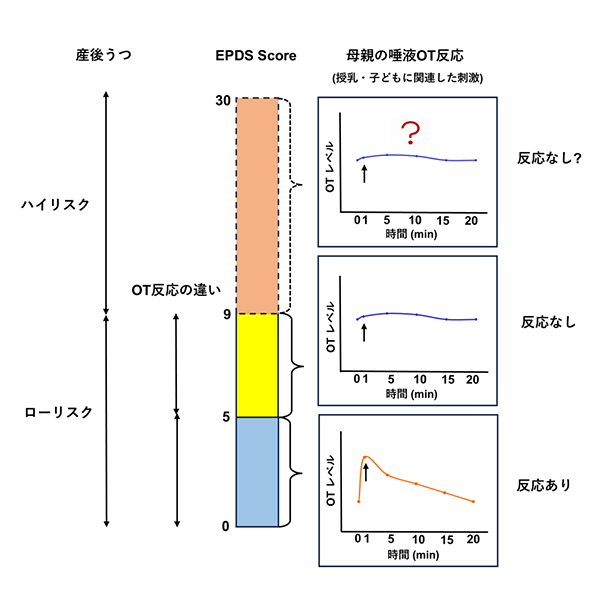
Figure: Summary diagram of this study
Child-related stimuli significantly increase maternal salivary OT. On the other hand, the response may cease to be observed after 5 EPDS points. Adapted from Minami et al., Frontiers in Endocrinology (2025), CC BY 4.0. (https://creativecommons.org/licenses/by/4.0/)
【Terminology】
*1 Postpartum depression
It is a type of depression that develops after childbirth and is classified as a specific term for “major depressive disorder – perinatal onset” in the DSM-5-TR (diagnostic criteria of the American Psychiatric Association).
Symptoms such as depressed mood (e.g., tearfulness, sadness, helplessness), anxiety, decreased motivation, sleep disturbance, decreased appetite, and low self-esteem last at least 2 weeks.
*2 Oxytocin (OT)
A neuropeptide hormone produced in the hypothalamus and released into the circulatory system through the neurohypophysis system. In the peripheral body, it promotes uterine contractions during childbirth and triggers the milk ejection reflex during breastfeeding. It is also released within the brain, where it facilitates affiliative and social behaviors and supports maternal behaviors such as bonding and caregiving.
Click here to see the press release【Japanese only】
Journal:Frontiers in Endocrinology
Researcher Information:MINAMI, Kana
TSUJI, Chiharu
HIGASHIDA, Haruhiro
Related Information
Laboratory of Midwifery and Women’s Field Web site: https://mw-web.w3.kanazawa-u.ac.jp/