
Cluster, Cloud and Edge Computing
Chairs: Paweł Czarnul
TorqueDB: Distributed Querying of Time-series Data from Edge-local Storage
Dhruv Garg, Prathik Shirolkar, Anshu Shukla and Yogesh Simmhan
Download paper from Springer LNCS.
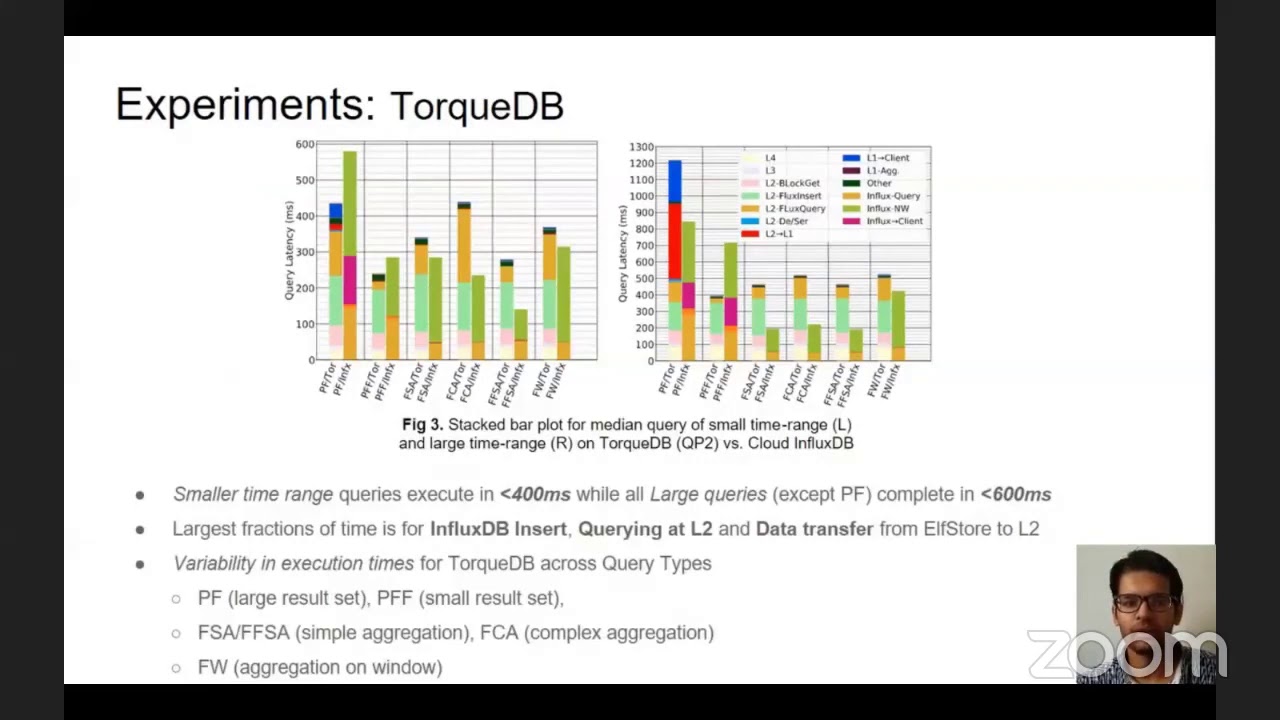
The rapid growth in edge computing devices as part of Internet of Things (IoT) allows real-time access to time-series data from 1000’s of sensors. Such observations are queried to optimize the health of the infrastructure. Recently, edge-local storage are helping retain data on the edge rather than move them centrally to the cloud. However, such systems do not support flexible querying over the data spread across 10–100’s of devices. There is also a lack of distributed time-series databases that can run on the edge devices. Here, we propose TorqueDB, a distributed query engine over time-series data that operates on edge and fog resources. TorqueDB leverages our prior work on ElfStore, a distributed edge-local file store, and InfluxDB, a time-series database, to enable temporal queries to be decomposed and executed across multiple fog and edge devices. Interestingly, we move data into InfluxDB on-demand while retaining the durable data within ElfStore for use by other applications. We also design a cost model that maximizes parallel movement and execution of the queries across resources, and utilizes caching. Our experiments on a real edge, fog and cloud deployment show that TorqueDB performs comparable to InfluxDB on a cloud VM for a smart city query workload, but without the associated costs.
Data-Centric Distributed Computing on Networks of Mobile Devices
Pedro Sanches, João A. Silva, António Teófilo and Hervé Paulino
Download paper from Springer LNCS.
In the last few years we have seen a significant increase both in the number and capabilities of mobile devices, as well as in the num- ber of applications that need more and more computing and storage re- sources. Currently, in order to deal with this growing need for resources, applications make use of cloud services. This brings some problems: high latencies, considerable use of energy and bandwidth, and the unavail- ability of connectivity infrastructures. Given this context, for some ap- plications it makes sense to do part, or all, of the computing locally on the mobile devices themselves. In this paper we present Oregano, a framework for distributed computing on mobile devices. Oregano is capable of processing sets or streams of data generated on mobile de- vice networks, without requiring centralized services. Contrary to the current state of the art, where computing and data are sent to worker mobile devices, our Oregano performs the computation where the data is located, significantly reducing the amount of data exchanged.
WPSP: a multi-correlated weighted policy for VM selection and migration for Cloud computing
Sergi Vila Almenara, Josep Lluis Lerida, Fernando Cores, Fernando Guirado and Fabio Verdi
Download paper from Springer LNCS.
Using virtualization, cloud environments satisfy dynamically the computational resource necessities of the user. The dynamic use of the resources determines the demand of working hosts. Through virtual machine (VM) migrations, datacenters perform load balancing to optimise the resource usage and solve saturation. In this work, a policy, named as WPSP (Weighted Pearson Selection Policy), is implemented to choose which virtual machines are more suitable to be migrated. The policy evaluates, for each VM, both the CPU load and the Network traffic influence on the assigned host. The corresponding Pearson correlation coefficients are calculated for each one of the VMs and then weighted in order to provide a relationship between the values and the host behaviour. The main goal is to clearly identify and then migrate the VMs that are responsible of the Host saturation but also considering their communications. Using the CloudSim simulator, the policy is compared with the rest of heuristic techniques in the literature, resulting in a reduction of 85% in the number of migrations, and thus reducing the use of bandwidth (6%), network saturation (24%) and over-saturated hosts (50%). Additionally, it is presented an improved VM allocation technique to reduce the distance the VMs must travel in order to be migrated, obtaining an average reduction of 43% in the quantity of migrated data.
WACOCA: People, Life, Style.