
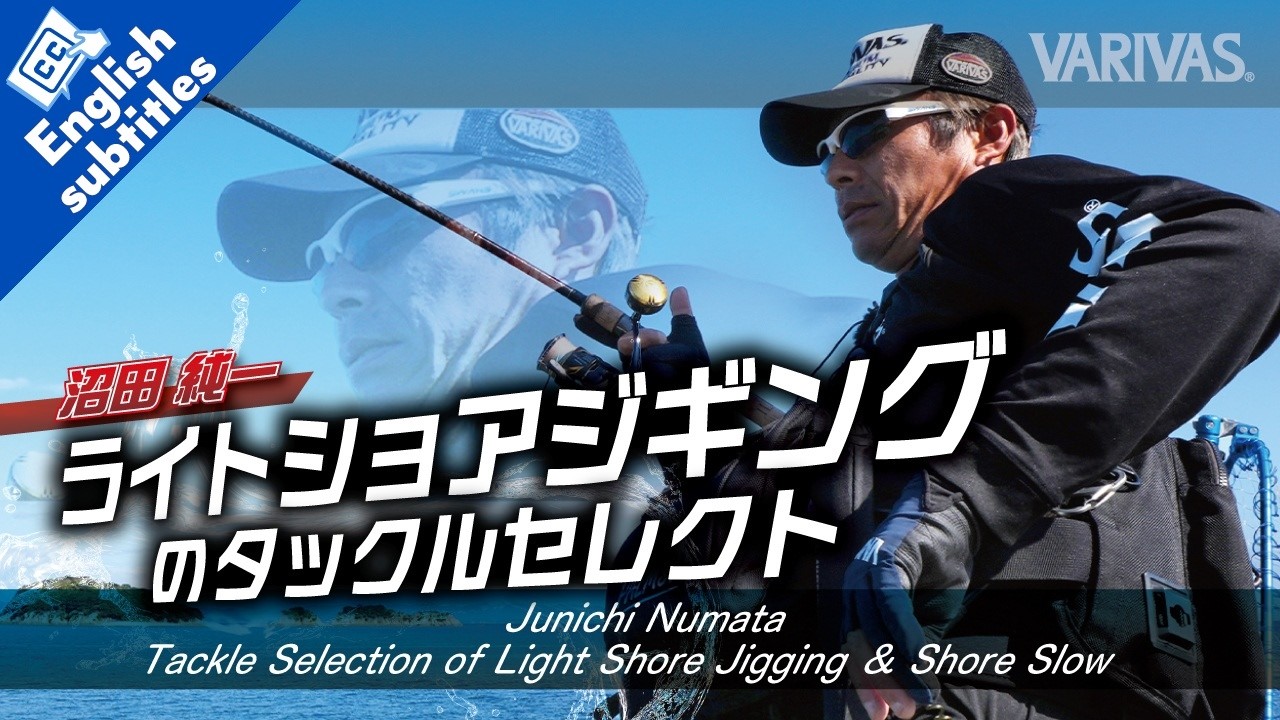
【ライトショアジギング】沼田純一のタックル解説 Junichi NumataTackle Selection of Light Shore Jigging & Shore Slow ★
Hello everyone, I’m Junichi Numata. In this video, I’ll be introducing ‘Light Shore Jigging’ and ‘Shore Slow Jigging’ — both techniques performed from the shore. I’ll explain the tackle setup used for these styles of jig fishing, as well as how to properly rig your fishing line. First, let’s talk about Light Shore Jigging. Here’s the tackle setup we’ll be using for this technique. This is the ShoreGun EVOLV 103H+ model, a rod that can cast up to 70 grams. This is the rod I’ll be using. So, what exactly is Light Shore Jigging? Let me give you a quick explanation. As a general guideline, Light Shore Jigging involves using jigs weighing less than 60 grams, and a main line lighter than PE 2.0. Fishing techniques that use this kind of setup are commonly referred to as Light Shore Jigging. When choosing a rod length, it’s important to consider the type of fishing environment. Light Shore Jigging is typically done in easy-to-access spots like breakwaters, rocky shores, and sandy beaches. So, you’ll be fishing in a wide variety of locations with different conditions. Because of that, when fishing from the surf, you often need extra casting distance. That’s why I use a 10-foot 3-inch rod — to maximize casting range. It really helps me reach farther, which is my main priority. I consider this setup to be a solid foundation for a wide range of fishing environments. Another important factor when choosing a rod is how easy it is to handle. For instance, if you’re not very confident in your strength or stamina, a longer, stiffer rod can be difficult to bend and control. In that case, a lighter 9-foot class rod can be a great alternative. Now, let’s move on to the reel. I’m using a size 4000 reel, equipped with the highest gear ratio — the XG model. When selecting a reel for Light Shore Jigging, you’re constantly jerking the jig, right? That motion creates slack in the line. To manage that slack effectively, you’ll want a reel with a fast retrieval rate — even within the 4000 class. That’s a crucial factor in maintaining a consistent retrieve rhythm. If you’re targeting larger fish, such as in rock shore fishing, you’ll need a larger reel.
In that case, you’ll still want the reel’s retrieval speed to match your jigging motion. But for Light Shore Jigging, a smaller reel size is the way to go. Here’s why: in Light Shore Jigging, the baitfish you’re imitating are typically quite small. Smaller baitfish don’t swim with as much power or range as larger ones, so… your jig movements should also be tighter and more compact to match their behavior. So when you’re imitating smaller bait, you naturally use smaller jigs and make smaller rod movements. That also means you don’t need to retrieve as much line per turn — everything is scaled down. Next, let’s move on to Shore Slow Jigging. I’ll introduce the tackle setup used for Shore Slow Jigging. For this type of fishing, we use a dedicated Shore Slow rod from the ShoreGun EVOLV series. The models include 991, 992, and 993 — the first two digits represent the rod length. That’s 9 feet 9 inches. The last digit indicates the rod power: 1, 2, or 3. You choose between them based on your target and the fishing conditions. These rods are labeled with power ratings of 1, 2, and 3. The power rating controls how much action you get when working the jig. Think of the number as a measure of strength and jig control. A higher number means a stiffer rod, where the main control comes from the retrieve, and the rod’s recoil adds more action to the jig, making its movement more pronounced. On the other hand, using a lower power rod creates a more natural or even subtle jig movement. So, when fish activity is low, choose a lower power rod. When fish are more aggressive, a higher power rod can trigger more strikes — that’s one key to selecting the right rod. If you’re new to fishing or want to try Shore Slow Jigging, you can absolutely start with a rod you already have. But eventually, a dedicated Shore Slow rod with a light body and a responsive tip will make your fishing much easier and help improve your technique. So, I definitely recommend considering a specialized rod as your setup progresses. For the reel, I recommend using a size 4000 to 5000 model with an extra high gear ratio — an XG model. That’s the reel I use for Shore Slow Jigging. As I mentioned earlier, retrieving the line is key in this style of fishing. You control the jig’s movement by adjusting your retrieve. For example, one full turn of the handle might move the jig about one meter. A half turn retrieves about 50cm, and a quarter turn moves the jig around 25cm. Since you’re controlling the jig’s movement through your retrieve, a higher gear ratio or a reel with greater line retrieval per turn — gives you more control and flexibility. By adjusting your retrieve pace, you can control exactly how far the jig moves. That’s why reel selection is such an important part of your setup. Now, let’s talk about the fishing line used for Light Shore Jigging and Shore Slow Jigging. Here’s the main line I recommend. This one right here: VARIVAS Jigging Max Power 10×10 X9. The X9 is a 9-strand PE line with a core for added stability. It has extremely low stretch. That’s a key feature of this PE line. Under tension, it stretches only around 3% — which is very low. That low stretch means you can feel and control the jig’s movement underwater with incredible precision. This line allows your hand movements to directly translate to the jig, making it easier to create the exact action you want at your target point. Even with a full cast — say, over 100 meters — this line doesn’t stretch, so you can still make the jig move exactly the way you want, even at long distances. That gives you incredibly direct control. You can apply just the right action to trigger a bite exactly where you want it. That’s what this line makes possible. Additionally, thanks to its inner core, the line’s cross-section is nearly a perfect circle. That helps reduce the impact of wind and current on the line. So no matter the situation, it pairs exceptionally well with jigs. This is a highly recommended line. For Light Shore Jigging, we typically use PE line in the 1.0 to 1.2 size range. That’s our standard setup. We choose based on casting distance and strength. For distance, I use 1.0. But when I need more pulling power — like to quickly land a fish, or to turn it forcefully toward shore — I often use size 1.2. Of course, this is all within the Light Shore Jigging category. You can go up to size 2.0, or down to 0.8 or even 0.6. But setting a baseline helps guide your line selection overall. That way, you can adjust more easily based on the conditions. So using size 1.0 to 1.2 as your main line gives you smoother, more versatile fishing. It gives you a solid foundation to build from. For Shore Slow Jigging, you’ll generally want to go one size up from Light Shore Jigging. Size 1.5 is the most common — and in some situations, I’ll even use size 2.0. The reason is that with Shore Slow Jigging, we want to take advantage of the PE line’s natural buoyancy. And thicker lines retain that buoyancy more effectively. That allows you to maintain control and keep the jig moving properly. Ideally, when the jig falls after hitting the water, you want to lift it straight upward. The line’s buoyancy helps maintain that vertical path. If the water’s surface is here, the line will naturally settle like this. When it behaves that way, your jig lifts more cleanly with each action. Because of that, using size 1.5 or 2.0 works well. It reduces snagging and helps create more effective lifts between falls, which is key to setting up that crucial bite. Another excellent choice for shore fishing is this one right here. It’s called, Casting PE Shore Master line. This is a line we often use in shore-based fishing games. So, how do we decide between the options? The Shore Master line is particularly known for its light weight and responsive feel. It’s extremely light, very supple and flexible. This means it creates minimal resistance when casting, and is hardly affected by the line’s own drag, even with lightweight lures. It truly allows the lure to perform at its best. For lures like minnows with high air resistance, the Shore Master line truly excels. This line allows lures to reach their full casting potential, maximizing distance effortlessly. So, here’s a simple rule to follow: If you’re mainly using jigs, go with the Jigging 9 braid. If you plan to use more minnows, the Shore Master PE is the better choice. That’s the key difference between these two lines. Now, for the leader to pair with them, I recommend this one: The Shore Record Shock Leader Fluorocarbon. What makes this fluorocarbon leader great is its flexibility. That softness is crucial when using small jigs, or lures that are sensitive to water resistance. In these situations, the leader’s softness really makes a difference. It helps bring out the natural swimming motion that the jig is designed to produce. That lifelike action makes even cautious fish more likely to bite. This leader enhances those bite-triggering movements. That’s one of the biggest benefits of its flexibility. Another key feature is its outstanding knot strength. When heavy tension is applied and a line breaks under load, it usually snaps at the knot — the most common weak point. But with higher knot strength, you can rely on nearly the full strength of the line — giving you extra confidence. It also has excellent abrasion resistance. Whether you’re fishing from a beach, jetty, or rocky shore, these environments can be tough on your gear. Even beaches can have ledges, drop-offs, or rocky bottoms that can damage your line. On jetties, sharp edges and wave breakers like tetra-pods are common hazards. This leader’s toughness makes it extremely reliable in such conditions. This line’s abrasion resistance makes it highly dependable in rough conditions. It lets you fight fish with confidence. On top of that, this leader is naturally resistant to damage — a key advantage. You might think, “There aren’t many obstacles in the surf, right?” But fine sand gets stirred up and rubs between the guides and line, causing wear over time. The same goes for when your jig scrapes along the bottom — it wears down the leader. With this leader, that kind of wear is much less likely. So you can fish confidently all day, without worrying about your gear. It’s a truly dependable leader. For leader length, I usually go with about 1 hiro — an arm-span, roughly 1.8 meters or 6 feet. That’s the standard length I recommend. To connect it to the main line, I use an FG knot. With thinner line, I usually make more warps than I would with thicker line. I usually do 12 to 14 wraps, counting each up-and-down as one. When tightening the knot, pull it firmly — but remember, thin line breaks more easily. That’s why I add more wraps to increase grip and strength, instead of pulling super hard like with thicker line. This makes the knot a bit longer, but it’s not an issue with thin line. Even with 13 or 14 wraps, it won’t interfere. I tie it this way for a stable, secure knot. The leader is 1 hiro (1.8 meters or 6 feet), but the key when casting is ensuring the knot stays outside the rod guides. In Light Shore Jigging, casting distance matters, so you want to avoid losing distance to friction. If the knot passes through the guides, it reduces your casting distance. To prevent this, keep the knot outside the guides. This is how I determine my leader length. For both Light Shore Jigging and Shore Slow Jigging, 1 hiro (1.8 meters or 6 feet) is ideal. With these upgraded lines and leaders, you have powerful tools in your arsenal. Light Shore Jigging and Shore Slow Jigging are exciting, and accessible ways to fish. We hope this video helps you enjoy those techniques even more.
メタルバスター沼田純一が【ライトショアジギング】のタックルセッティングを細かく解説!
皆様も参考にしてみてはいかがでしょうか。
【沼田純一】使用製品
■ アバニ ジギング10×10 マックスパワーPE X9
https://www.varivas.co.jp/Product/searchgroup/id:5101
■アバニ キャスティングPE マックスパワー X8 ショアマスター
https://www.varivas.co.jp/Product/searchgroup/id:4696
■ショアレコードショックリーダー [フロロカーボン]
https://www.varivas.co.jp/Product/searchgroup/id:5139
■関連動画
【ショア道Vol.1】沼田純一×佐渡島 ヒラマサ ロックショアゲーム
【ショア道Vol.4】沼田純一×キハダ ロックショア ビックゲーム
【ショア道Vol.8】沼田純一×小豆島 瀬戸内海ライトショアジギング攻略
– – – – – – – – – – – – – – – – – – – – – – – – – – – – – – – – – – – – – – – – – – – – – – – –
【VARIVAS WEB SITE / SNS】
◆WebSite https://www.varivas.co.jp/
◆Instagram https://www.instagram.com/varivas_japan/
◆Facebook https://www.facebook.com/MorrisCoLtd/
◆X(旧Twitter)https://twitter.com/varivas_jp
◆LINE https://lin.ee/u1aU9Ea
◆ノット大図鑑 https://www.varivas.co.jp/cms/notes/
◆リグ大図鑑 https://www.varivas.co.jp/cms/rig/
– – – – – – – – – – – – – – – – – – – – – – – – – – – – – – – – – – – – – – – – – – – – – – – –
2 Comments
何回もも見た
しなやかさを取るなら高品質ナイロンの方がいいのでは・・・
フロロカーボンのパッキパキな特性を生かしてジグをトラブルレスで動かす、という用途でフロロリーダーを使うことはあるけど
メインラインはバリバスのキャスティングPE、これは本当に良いライン