
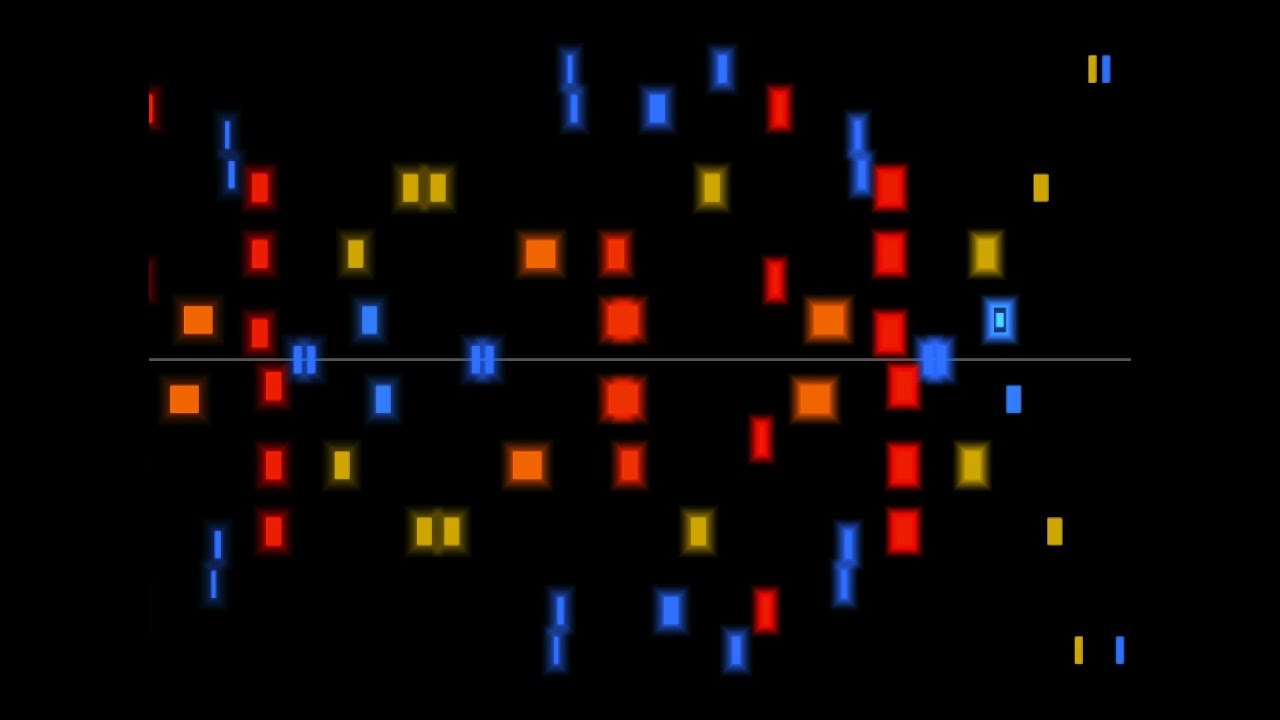
Anton Webern’s Variation no. 2, opus 27, accompanied by a graphical score.
FAQ
Q: What do the colors mean?
A: The colors show the dynamics (loudness) of the notes, as indicated in the score.
Q: What the heck was that?
A: This is a piece that I selected for inclusion on my first publicly-released videotape; the animations in that set are listed as “Program 1” here:
http://www.musanim.com/store/
I chose it because it showed something that most pieces don’t have (and which is not so obvious in conventional notation: pitch symmetry. If you’d like to compare, see:
http://www.musanim.com/pdf/WebernOpus27n2.pdf
Q: Could you do a MAM video of _________?
A: Please read this:
http://www.musanim.com/requests/
22 Comments
Smalin, I am SO glad you made this video. Webern, or any of other post-tonal composers, don't get the right attention they deserve.
By the way, at 0:14, the high Bb and G# don't repeat. The Repeat of the first section does NOT include the incomplete measure.
Complete garbage. I can't believe anyone takes this seriously.
I have to play this!
This visualisation shows that Webern knew what he was doing and not just pressing notes at random. This is because of the broad colour scheme in this. ( harmonies notes would have analogous colours.)
I don't know why I seem to be drawn to this, it sounds so terrible yet so very intriguing at the same time.
I don't get it, but I get the feeling it would grow on me, like the New England Triptych.
Amazing visualisation!! the only thing is that the last 2 notes of the first section shouldn't be repeated, the repeat continues from the second bar.
Amazing work!! Thank you so much!!
Nice!
This is very gay tbh, this guy has nothing on Harry Styles….
This is very interesting, I am studying Music Theory and it makes a lot of sense when you understand why he composed this piece in this way. The point of his piece is a collection of what they call: Twelve tone technique, this technique is in an incredible way expressed in this piece!
this is deep and brilliant.
more Webern please.
if you look into the blackhole long enough it will start to look back at you
Weberns one of my favorites but ive always hated this piece. Sounds like 15 year old me fucking around in garageband.
I just heard this in the Sopranos. Had to come back and listen to it again after 3 years.
How did I miss this back 4 years ago? Thanks for doing it this way, smalin! It is entirely comprehensible as a whole and you helped me see it this way, though I've known it for many years already. Would be harder to do with other parts of Op. 27, but no need to try. (Though I'd be super interested to see how you did it.) I studied with a Webern student (yeah, I'm old!) and feel a real connection to him, Krenek, Berg and other Viennese peeps. I enjoy the range of things you do, from the Rite of Spring to Brandenburg 4. Thanks for your significant contributions here!
Heard this in the Sopranos and had to do some digging to learn about this piece. As someone completely uninitiated into the world of music theory, it sounded bizarre and ugly. I read some analysis and still didn’t really get it… but the visualization you provide with this video has helped me understand the value of this piece so much more. Thank you.
I don't get it
The famous webernian symetry. Love it.
Compared with the music score in FAQ. I found two superfluous note after last two note B flat, E flat in 11th bar in the video. The score shows the right play is: B flat, E flat then repeat from 1st bar, A, A.
Brilliant! It's so beautiful to see the structure of the music, the use of blank space and counterpoint. Many thanks.